http://www.stopbullying.gov/
This link helped me extremely while I was making our game demo. It gives plenty of facts and statistics about bullying which helped me with the content of our game. This website gives advice on how to stop bullying in schools, at home, etc... Adding buttons to our game demo was probably one of the most challenging parts of making our game. It was confusing at first, but now I have all of them done and working.
Thursday, April 14, 2011

Adding Scenes

Wednesday, April 13, 2011
A New Concept
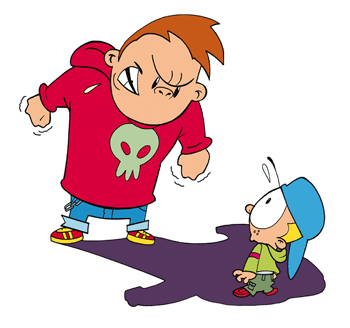
We have learned many ideas and facts about are game topic since we started developing our game.One of the things we learned was the statistics on bullying:
1 out of 4 kids is Bullied. The American Justice Department says that this month 1 out of every 4 kids will be abused by another youth.
Surveys Show That 77% of students are bullied mentally, verbally, & physically.
In a recent study, 77% of the students said they had been bullied. And 14% of those who were bullied said they experienced severe (bad) reactions to the abuse.
1 out of 5 kids admits to being a bully, or doing some "Bullying."
8% of students miss 1 day of class per month for fear of Bullies.
43% fear harassment in the bathroom at school.

I learned this by researching information for our game on Google.These statistics made things easier for our game because we knew a little bit more about our game idea.These statistics may or may not be trustworthy because numbers change and vary in different areas but it did give us a start for our knowledge of our game topic.
Monday, February 28, 2011
Planning Your Game
Brent comes up with all the ideas for the game, and looks up information.
Jacey takes Brent's ideas and information, and puts it in the game, and on the websites.
I'm doing the design of the game, and the actual game coding. I'm good at this, because I grew up around design, and I want to be a graphic designer after I get out of school.
I look forward to not having to do everything by myself in the game, so it goes easier.
Deciding who does what. We generally are able to come to an agreement pretty easily.
Friday, February 11, 2011
Mini Game Project
We finally finished the Mini Game Project, and got it posted to the Wiki. I'm glad to be finally finished with this, because trying to figure out the code and such when nothing was working was beginning to get old. I generally don't ever play games in my free time.
Friday, February 4, 2011
Progress.
Progression with the mini game project is going well. I've got the carrot moving, and bouncing off the rabbit. Everything works until it comes to putting the score on the game. Then it freezes. My biggest frustration with this class is when the coding is wrong, and it won't let anything work.

Wednesday, January 19, 2011
- WHO are you designing your game for? (Include the player's age, abilities, and prior knowledge of your topic.)
- WHAT will your game teach the player about your topic? (Be specific!)
- WHERE does your game happen?
- Describe the world you will design for your game.
- How will this setting add to the learning experience?
- HOW does your game world teach the player about your topic?
- What happens in the world that helps the player learn?
- How does the player use what they learned to make something happen in the game?
- WHY is a game a better way of understanding your topic than a quiz?
Subscribe to:
Posts (Atom)